In this entry of the director's notebook I will be talking about character customisation and setting adjustability. The whole idea of talking about these two is that both these characteristics of the performance are the main visuals. Firstly I will talk about character customisation followed up with setting adjustability.
Character customisation was a big part of our performance giving the characters a realistic outlook as well as entertaining the audience were the main aims. In order to achieve this we used a lot of things to make the character realistic and interesting for the audience.
Costumes were a big part of our performance trying to create a realistic costume for my character was quite difficult. As a group we settled on a checkered shirt for my character as well as donning some accessories in the form of glasses and the tattoo seen in the scene. Why did we really elaborate on the costumes? because we really wanted to give the feel of the real movie along with the camera angles.
Another thing we really looked at was the setting and how it could have been adjusted to better effect therefore we used the lighting to our advantage keeping the movie in lowlight mainly. The whole idea was also that we kept the lighting dim to co-operate with our moods which were very low, tired and lazy.
Adding on to that another setting adjustment would we tried to make was making the room messed up therefore adding to the 'hangover' effect. The whole room and bathroom were set up as a place that is rundown and therefore implies the effect of the whole scene in general and made the idea of the hungoverness more realistic therefore improving the level of our performance.
The last thing I would like to talk about is the link between the two. The characters helped to make the setting more valid and this was because the whole link between the two was shown in the fact that we kept the characters at a point in the camera where we could see the background extensively.
Wednesday, 15 June 2016

Tuesday, 14 June 2016
Task 4, Commentary: Reflection
https://www.youtube.com/watch?v=-xGuxpkuql8&feature=youtu.be
Task 2, Proposal: Entry 1, Director's Notebook
Our final performance planning has just started with us as a group doing a scene from the action-comedy film Hangover 2. The film has a lot of comedy scenes and my vision for our final performance will be explained throughout the three blog updates (including this one).
I don't see our performance live because that will kill the effect of the comedy and therefore us not being able to make the impact we want to. The whole idea of having the performance on a video sounded more realistic than that of a live performance. The live performance will explore a lot of camera angles, character customisation, setting adjustability and much more. In this specific post I will like to talk about creative camera angles in depth.
The creative camera angles are all the angles apart from the basic camera angles used in everyday films these will be more in depth angles which help us look at the subject more.
We are planning to have quite a few camera angles one would be from the character eyes point of view. This angle will look a lot like an angle where we want to really experience the feel of being that specific characters. The technique we are going to use is having a phone taped to our heads with the camera as close as we can to the eye along with the heat not causing a disturbance to the actor. The camera angle panned out very well in our clip giving us a new dimension.
Our second camera angle I will talk about was only used once within the entire video but turned out to be very effective. The focus shot was designed to focus on the alcohol which basically was the 'cause' of this disaster. The whole idea was to really look at the glass and think how did this happen and the audience to know ahh this is how it happened, short yet extremely effective.
Another camera angle we used was the wide-shot which covered a lot of the objects in the room. The whole idea behind this type of shot was to really exercise the effect of 'hungoverness' in a messy room this shot covered most of the bathroom and that was the main aim of having such a shot. Another reason this shot was used to give a new angle for the audience which also helped us keep their attention.
Finally the last camera angle we used was the moving shot which was again to help boost the audience's perspective on the performance. This angle was mainly used to aid the flow of the performance used at crucial scenes in the performance to ensure the audience knew what was happening when and how it happened, the angle was most frequently used when Allen and Phil look for Stu.
In the next post I will be talking about how we looked at how we could really bring the characters to life and how the setting also was made realistic in the video.
Friday, 22 April 2016
'Scenes from Othello' Reflection :)
In the play Othello, I played the main character himself which was Othello. I tried to get in character for the play by behaving like Othello outside of the play basically generally when I was in public. I aimed to practice my lines about 3 three times a day 2 weeks before the actual performance to ensure the fact that I knew my lines well before the play. In terms of the audience I had to look confident yet unsure in my scene a bit like being split between two personalities.
The parts in my scene where I really got angry or so became a 'dark' human being were the most effective because to the audience it was the most exciting,scary and highlighted the fact that the line I said while talking like that was an important line. In terms of specific lines I delivered quite a few good ones especially my last few lines which I delivered in a very dark and low-key tone.
My greatest challenge was the actual performance how everything would come together on the real day, learning my lines hoping that my partner did as well, making sure I portrayed my character well & a number of other things. After working hard practicing lines day by day, coordinating with my scene members and eventually getting to the day essentially everything came together much better than I expected.
Generally the performance was alright I'm talking about the play as a whole, in terms of my own performance I would have to say I did pretty well but as usual there was room for improvement. I should have possibly practiced more and maybe my stage performance in terms of my movement was not as great as I wanted it to be. I would try to make a stronger attempt to in general improve my on stage performance by getting more involved in drama performances and in class.
During this long, tiring yet rewarding process I have possibly not learnt a lot of new skills but I have solidified on skills I already have. Things like voice projection, confidence and teamwork have just become better for me a new skill would be performing an actual performance in front of a group of people, that was a very interesting first for me.
The best part of the entire unit was getting to know that we will be performing it to a large audience compared to what we are used to. Another great part of the unit was just the variety of things we learnt, experienced and developed on. Knowing about the play prior to learning in class helped, the experience in general was the most valuable thing for me.
As mentioned earlier I would just improve on bits pieces of the whole process because to be honest I feel that I have done extremely well from start to end. The process we followed as a group was straightforward and clear it's just about perfecting it and possibly dedicating more time to it. Overall though minor improvements because there is always room to improve!!!
To conclude I would like to take the opportunity to say that this entire experience has been of of the best things in my life and the best drama related assessment I have ever done. Through the minor lows and major highs this 'Othello' performance was one of the most enlightening, wonderful and thoroughly enjoyable experience I have been part of in a drama point of view. Ending the unit on a high was essential and I feel I have achieved that.
Shawn Simon 10C
Saturday, 27 February 2016
'Othello' Character
My Othello drawing added with a written description on the picture. Mind my drawing skills as I am not great at drawing but this was one of best pieces to say the least.
Inquiry Questions:
1. Why did I pick Othello?
2. What is Othello's status?
3. How does this affect my drawing?

Monday, 8 February 2016
Iago's Monologue
Friday, 29 January 2016
'Special Effects' In the globe theatre
'Special effects' were described using language in Shakespeare's time but in contrast to the playwrights who described special effects using language there were acting companies that could produce special effects on a dramatic level. For example lightning and thunder filled theatres that needed 'storms'. Money was not always invested into theatre and getting the 'ingredients' for special effects was expensive therefore special effects could be used in moderation.
Exactly how were special effects made?
In terms of thunder the effect was produced by either rolling a cannonball (a heavy ball that made a thunder like sound) across stage or drums were beat offstage. In those days there was actually something called a thunder machine (A box balanced like a seesaw that used a cannonball which rolled side to side to make the noise). Flashes of lightning were also made by throwing a type of powder into a flame to make a flash. Artificial 'lightning bolts' were made by attaching a wire to two sides of a stage which was attached to by a firecracker. The firecracker then gave them that lightning like effect which was entertaining for all watching. The firecracker shot from top to bottom or side to side giving a firework that lasted for about 5-8 seconds.
Things can go wrong with special effects to right?
Special effects rarely go wrong but 29th June 1613 they did. The prestigious globe theatre burnt down during a performance of "Henry VIII" a Shakespeare play, this was considered as big news especially in that time as things like this did not happen often. Ingredients used to make special effects did not always smell nice especially when set alight. Sulphur smells like a rotten egg and saltpetre (made from cow dung) already smells bad when mixed up and worse when set alight they were both put together to make gunpowder. These are used when the witches in Macbeth make smells the air in the theatre actually was not dangerous but just disgusting to breathe in.
How about spells and magic?
Plays from Shakespeare's time had a lot of influence from spirits. gods, goddesses and they usually entered through a trapdoor from above 'heaven'. The actors/actresses were usually lowered in by a strong wire this process or descending act was called 'flying in'. Obviously for positive and good spirits there are bad spirits (evil spirits, devils) that came up from 'hell', under the stage through a trapdoor. Firecrackers were the normal thing when a devil appeared or witchcraft or magic was used. Dr Faustas (a popular Christopher Marlowe play) had one such production where the devil put firecrackers in their mouth to suggest they were 'breathing fire'. Companies related to theatre used smoke as a magic effect and the best part about smoke was that it could be coloured (depending on what chemicals were used). Real fire was used shrewdly as it could be dangerous to the wood and the globe theatre (fire was why the globe 'burned down'). Flames were rarely needed but if they were needed strong alcohol was mixed with different types of salts depending on what colour of flames were needed.
 Theatre companies used smoke mostly as a magic
effect, although it was sometimes used to suggest a fire.
They could make black, white, yellow and red smoke –
depending on the chemicals they mixed together. They
used real fire as little as possible, it was very dangerous
in a wood and thatch building. If they needed flames
they burned strong alcohol mixed with a variety of salts,
depending on the colour they wanted the flames to be.
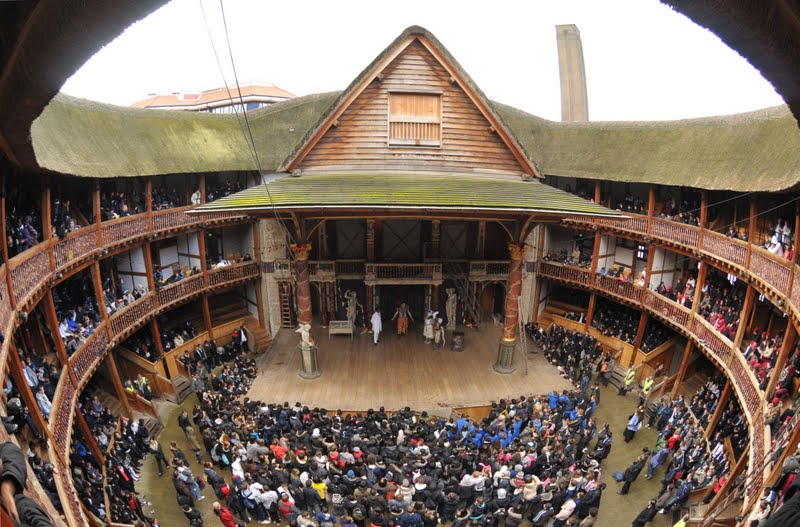
Now the globe theatre has been restored into a modern version and is still based in England where the old theatre was and still has plays dating well back into William Shakespeare's time.
I did not know that they used ingredients for special effects even though I did not know it still did not surprise me. Another thing was that I did not know that the globe had plays that were not only Shakespeare's.
Interestingly I found the fact that people actually had the guts to put firecrackers in their own mouth amusing which is quite scary as well because I know that it is not a small thing to put your mouth and taste buds at risk. That was quite daunting also because health standards was high nowadays.
Shawn 10C
Exactly how were special effects made?
In terms of thunder the effect was produced by either rolling a cannonball (a heavy ball that made a thunder like sound) across stage or drums were beat offstage. In those days there was actually something called a thunder machine (A box balanced like a seesaw that used a cannonball which rolled side to side to make the noise). Flashes of lightning were also made by throwing a type of powder into a flame to make a flash. Artificial 'lightning bolts' were made by attaching a wire to two sides of a stage which was attached to by a firecracker. The firecracker then gave them that lightning like effect which was entertaining for all watching. The firecracker shot from top to bottom or side to side giving a firework that lasted for about 5-8 seconds.
Things can go wrong with special effects to right?
Special effects rarely go wrong but 29th June 1613 they did. The prestigious globe theatre burnt down during a performance of "Henry VIII" a Shakespeare play, this was considered as big news especially in that time as things like this did not happen often. Ingredients used to make special effects did not always smell nice especially when set alight. Sulphur smells like a rotten egg and saltpetre (made from cow dung) already smells bad when mixed up and worse when set alight they were both put together to make gunpowder. These are used when the witches in Macbeth make smells the air in the theatre actually was not dangerous but just disgusting to breathe in.
How about spells and magic?
Plays from Shakespeare's time had a lot of influence from spirits. gods, goddesses and they usually entered through a trapdoor from above 'heaven'. The actors/actresses were usually lowered in by a strong wire this process or descending act was called 'flying in'. Obviously for positive and good spirits there are bad spirits (evil spirits, devils) that came up from 'hell', under the stage through a trapdoor. Firecrackers were the normal thing when a devil appeared or witchcraft or magic was used. Dr Faustas (a popular Christopher Marlowe play) had one such production where the devil put firecrackers in their mouth to suggest they were 'breathing fire'. Companies related to theatre used smoke as a magic effect and the best part about smoke was that it could be coloured (depending on what chemicals were used). Real fire was used shrewdly as it could be dangerous to the wood and the globe theatre (fire was why the globe 'burned down'). Flames were rarely needed but if they were needed strong alcohol was mixed with different types of salts depending on what colour of flames were needed.
 Theatre companies used smoke mostly as a magic
effect, although it was sometimes used to suggest a fire.
They could make black, white, yellow and red smoke –
depending on the chemicals they mixed together. They
used real fire as little as possible, it was very dangerous
in a wood and thatch building. If they needed flames
they burned strong alcohol mixed with a variety of salts,
depending on the colour they wanted the flames to be.
Now the globe theatre has been restored into a modern version and is still based in England where the old theatre was and still has plays dating well back into William Shakespeare's time.
I did not know that they used ingredients for special effects even though I did not know it still did not surprise me. Another thing was that I did not know that the globe had plays that were not only Shakespeare's.
Interestingly I found the fact that people actually had the guts to put firecrackers in their own mouth amusing which is quite scary as well because I know that it is not a small thing to put your mouth and taste buds at risk. That was quite daunting also because health standards was high nowadays.
Shawn 10C
Subscribe to:
Posts (Atom)